Mixed Media at Aceable

Timeline
2022-Now
Company
Aceable
Role
Graphics Design, Motion Design, AI Generative Design
Tools
Photoshop, Illustrator, After Effects, Audition, MidJourney, Nano Banana
Deliverables
Promo videos, website visuals, paid and organic social media assets
Project Overview

In 2022, Aceable’s marketing team asked for a new promotional video for the Real Estate course. It began as a single project, but it quickly became an opportunity to define a stronger visual language for the brand.
At the time, Aceable already had clear brand colors and typography, but no distinctive visual style for marketing content. Together with another motion designer, I helped develop a mixed-media design approach that combined photography, illustration, and motion. This new style proved to be flexible and engaging, and it has become Aceable’s primary visual language across campaigns, landing pages, and social channels since then.
The Challenge
As Aceable expanded its media presence, the lack of a clear visual identity became more noticeable. Marketing assets across different channels felt disconnected and didn’t fully reflect the brand’s playful and accessible personality.
The goal was to create a visual system that could make Aceable stand out in the e-learning space while remaining flexible enough to scale across multiple formats, platforms, and course verticals.
My Role & Collaboration
I collaborated closely with another motion designer during the early development of the visual style. After an initial brainstorming session we were both leaning toward collage-style visuals, he created the first storyboards while I helped refine the direction and visual language.
We split animation work for the first promotional video, and he took care of the sound design and final delivery. From there, the mixed-media approach became a shared toolkit for our team. Depending on the project, we would either collaborate or take ownership of different pieces while maintaining the same visual system.
Over time, I continued expanding the style across sales campaigns, landing pages, and social content.
The Process
Discovery & Inspiration
We initially explored a fully illustrated style but quickly ruled it out due to the time and specialization it required.
Collage and mixed media stood out as a better solution. It allowed us to combine photography, vector graphics, and playful compositions to create something visually attractive while remaining efficient to produce.
One of the artists who influenced the direction was Ariel Costa, whose work blends bold vector design with photographic elements.
Workflow & Tools
The style lives at the intersection of three things:, photography, vector graphics, and motion, so the workflow had to support all three working together seamlessly.
Assets were built in Illustrator and composited in Photoshop, where photo editing, cutouts, and layering happened before anything moved. After Effects handled all animation, with Premiere Pro and Audition brought in for final assembly and sound. As the style matured and stock photography started feeling repetitive and limiting, I began using AI image generation tools, primarily Midjourney and Photoshop's generative fill, to create more unique characters and scenarios that fit the brand without relying on the same repetitive image libraries everyone else was pulling from. It kept the visuals feeling fresh without changing the workflow in any significant way.
Iteration & Feedback
Throughout development, we explored a few visual directions before presenting options to the marketing team. While alternate styles were also on display, the mixed-media approach stood out immediately for its energy, flexibility, and production efficiency.
After the first promo video launched, the style continued evolving as we applied it to new campaigns and formats. Each new project helped refine how photography, vector graphics, and motion worked together, gradually shaping a more consistent visual system for the brand.
Feedback from marketing and leadership played an important role in this evolution, helping us adjust composition, pacing, and messaging so the visuals remained clear, engaging, and aligned with campaign goals.
AI Integration
Early versions of the style relied heavily on stock photography, which quickly started to feel repetitive and limited.
To expand the visual possibilities, I began integrating AI tools into the workflow, including:
- Midjourney for generating new characters and scenarios
- Gemini for quick image variations
- Sora/ChatGPT for concept exploration and object generation
- generative AI tools in Adobe Photoshop for image refinement and compositing
These tools allowed me to create more unique visuals while maintaining consistency across campaigns and reducing reliance on repetitive stock imagery.
The Solution
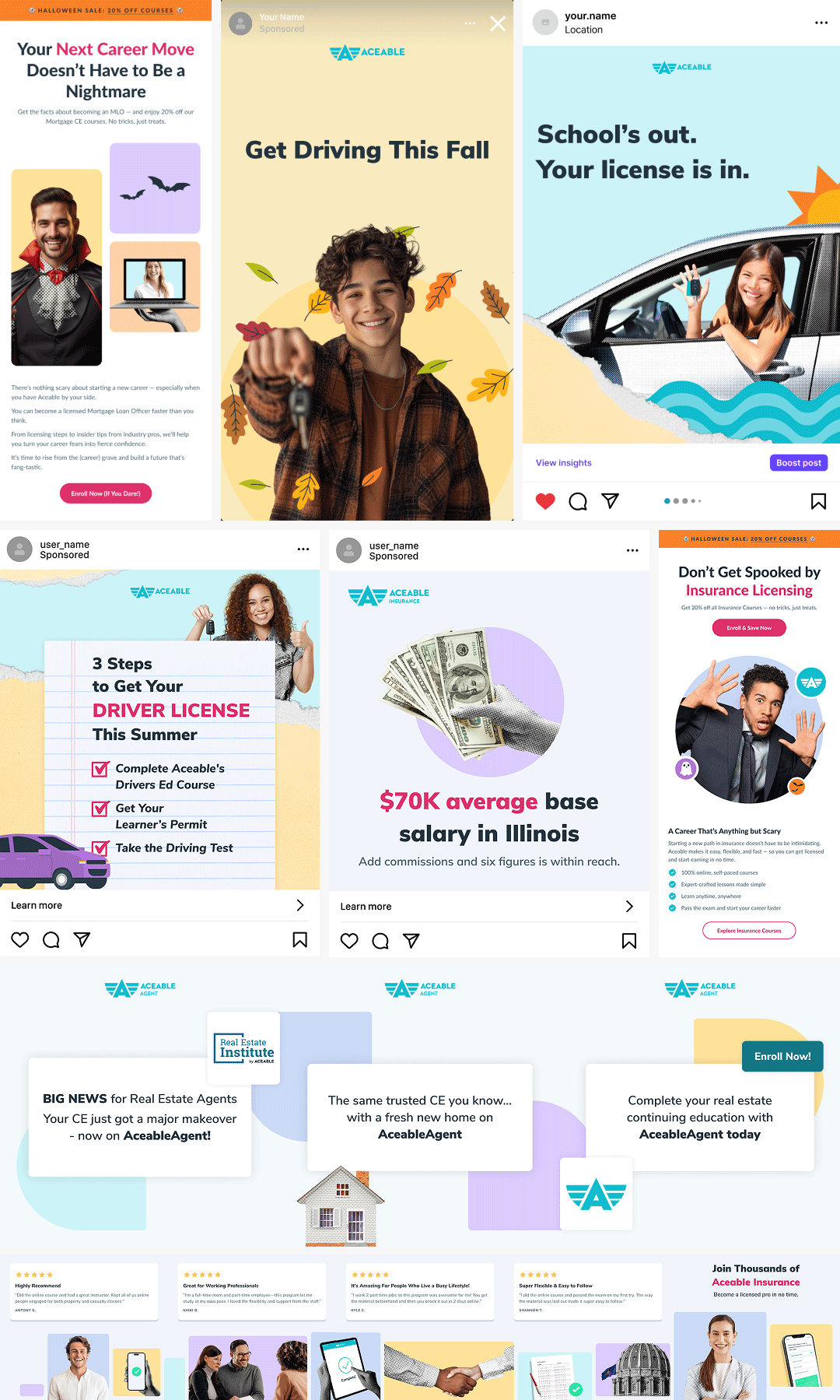
The first Real Estate promo video launched successfully and was soon followed by a Teen Drivers Ed campaign. As Aceable expanded into additional verticals, including Mortgage and Insurance, the mixed-media style carried through seamlessly.
When the marketing team later pushed for a web redesign, I adapted the visual language for landing pages by creating a set of mixed-media illustrations designed specifically for web layouts.
This work led me to build the Core Image Library in Figma, a centralized collection of brand imagery organized by size and use case. The library would now allow marketing, product, and design teams to quickly access consistent visuals and reduced the need for repeated design requests.
Over time, I created dozens of mixed-media assets and motion pieces across campaigns, social platforms, and product experiences.

Impact
What started as a brief for one promotional video became Aceable's primary visual identity across every marketing channel. The mixed-media style is now used across landing pages, paid and organic social campaigns, CTV advertising, email marketing, and in-course content, and it's been that way since the first campaign launched.
The early results showed stronger engagement and conversion performance compared to previous creative, and internally the response was immediate. Marketing, product, and leadership all aligned around the style quickly, which is how it went from one video to a full brand system in a relatively short time.
To support consistency as the style scaled, I built the Core Image Library in Figma, a centralized collection of brand imagery organized by size and use case, so marketing, product, and design teams could access visuals independently without going through a design request every time.
Reflection
We didn't set out to define a brand. we set out to make one good promotional video.
Looking back, what made this work wasn't just the visual style, it was that the style was designed to be used by a small, fast-moving team. Flexible enough to work across formats, distinctive enough to be recognizable, and simple enough that it didn't require a specialist to execute every time. That's what gave it staying power.
It also taught me something about how design systems actually get adopted: they have to make people's lives easier, not just look better. The Core Image Library exists for the same reason the style does, because good design should scale without breaking.