Drive Like Your Future Depends On It


Timeline
2025
Company
Aceable
Role
Concept, AI Generative Design, Video Editing
Tools
ChatGPT, Sora AI, Suno AI, After Effects, Audition, Premiere Pro
Deliverables
AI-generated music-video style spot
Project Overview
Drive Like Your Future Depends On It is an experimental music-video-style ad that reimagines learning to drive across three decades, the 80s, the 2000s, and today, each with its own visual aesthetic, musical style, and emotional energy. The lyrics, song, and all footage were generated using AI, with traditional motion design polish bringing it all together in post.
This one started as a personal experiment. I wanted to find out how far AI tools could go when guided by a strong creative concept rather than left to generate randomly. A year later I'm still proud of the result, which feels like the best answer to that question.
The Challenge
The main question driving this project was could a single person develop an entire ad, story, visuals, lyrics, and soundtrack, using AI as the production engine, without losing narrative clarity, emotional resonance, or brand personality?
The trickiest technical problem came from the way AI-generated footage handles camera movement. AI simulates perspective rather than capturing real optical movement, which means certain frames can distort during zooms and camera shifts. To place the Aceable app screen onto a phone convincingly in the final scene, I manually motion-tracked the shot and fixed subtle distortions frame by frame. Small details the eye wouldn't normally catch, but the kind that make the difference between something feeling real and something feeling off.
My Role & Collaboration
This was a solo end-to-end project, created outside of my regular responsibilities with full creative ownership from concept through final delivery. Concept, script, lyrics, art direction, prompt engineering, AI generation, editing, motion tracking, and final polish. All mine.
I shared early explorations with Aceable's creative and leadership teams along the way, which helped them start visualizing what AI-driven media could look like in practice. But the creative process itself was entirely self-directed, which was exactly the point.

The Process
Discovery & Inspiration
The starting point was a campaign by Wistia called Complete Control, an AI-driven music video they created and then documented publicly, walking through their tools, prompts, and creative thinking. I found the behind-the-scenes as inspiring as the video itself. It made me want to find out what was possible when the same approach was driven by a stronger narrative concept.
The decade structure came early and felt right immediately. Learning to drive is a universal experience, but what it looks, sounds, and feels like has changed completely across generations. Building the video around three distinct eras, the 80s, the 2000s, and today, gave the piece a natural arc and a reason to shift visual and musical styles without it feeling random.
I wanted the final result to feel fun and current, a little nostalgic, a little futuristic, and made with intention rather than just generated and assembled. That distinction mattered to me from the start.
Workflow & Tools
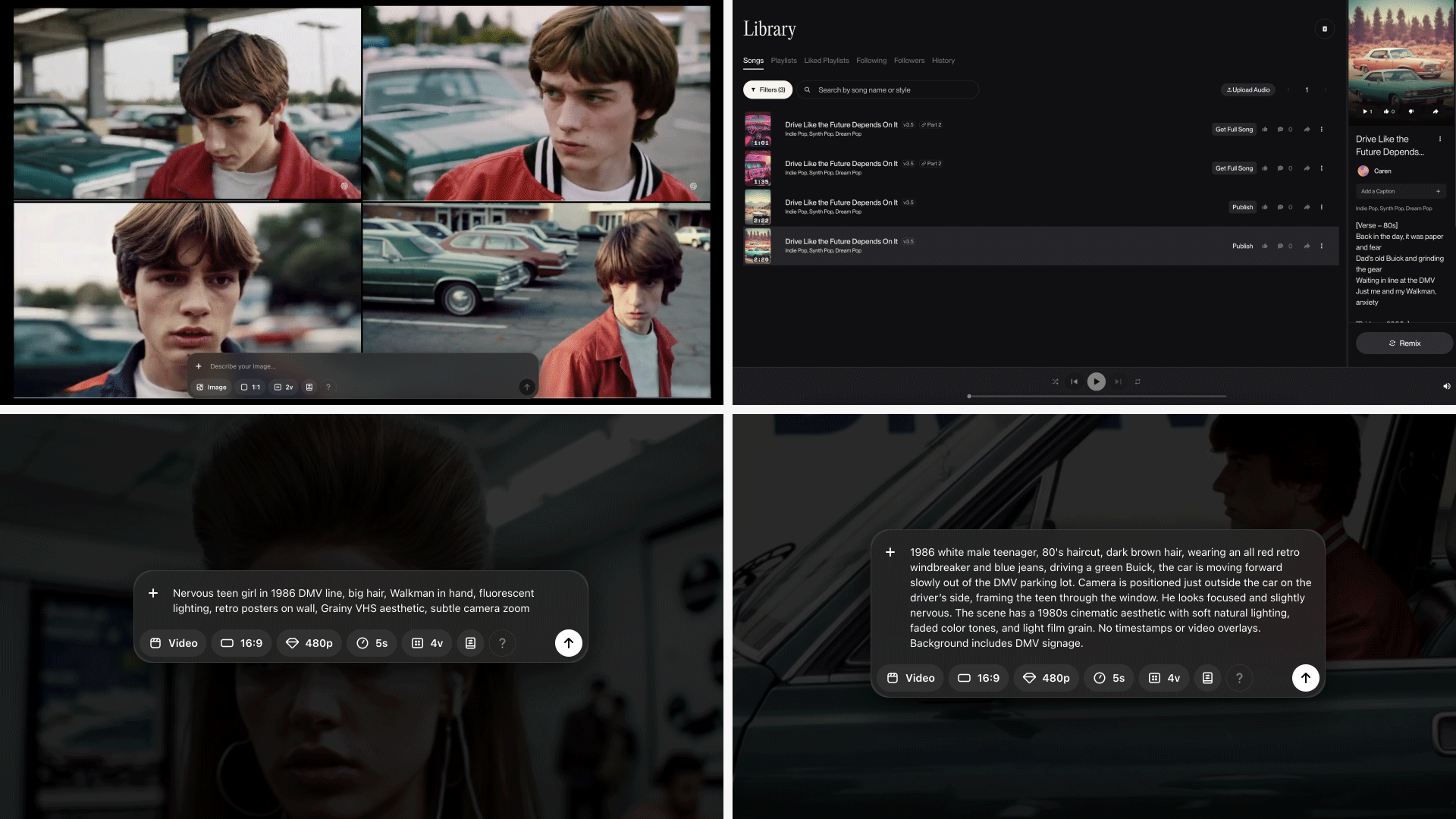
The process started with a scene-by-scene plan built around the decade structure. I used ChatGPT heavily in the early stages to brainstorm story beats, shape the lyrics, and build out prompts with precise visual cues. Getting the prompts right was its own creative discipline, a single word could shift tone, silhouette, lighting, or era completely, so the language had to be intentional from the start.
All footage was generated in Sora. Each decade had its own visual brief: grainy, warm film textures for the 80s, camcorder aesthetics and saturated colors for the 2000s, and clean cinematic high-contrast visuals for today. The song was generated in Suno, with the musical style shifting across the video to match each era.

Post-production happened in After Effects, where I added color correction for decade accuracy, light grain, analog distortion, VHS effects, transitions, and pacing tied to the music. Photoshop handled small frame-by-frame fixes where Sora needed a little help.
Tools: ChatGPT, Sora, Suno, Adobe After Effects, Adobe Photoshop
Iteration & Feedback
The biggest iteration challenge was character consistency within each decade. I wanted the same boy driving the Buick to be the same confused kid at the DMV parking lot, but AI had a hard time holding a character across multiple scenes. Getting that continuity right, while also maintaining the specific visual aesthetic, camera style, and era feel of each decade, required increasingly precise prompting, clothing details, hair style, car model, color cues, lighting, time-of-day, shot size, lens characteristics. By the later sections of the video I needed far fewer attempts to get the output I was looking for, which showed how fast the workflow improved just through doing.
I shared the piece internally once it was assembled and the reaction was immediate and positive. It opened up conversations about AI-assisted production that hadn't been happening before, which felt like a worthwhile outcome on its own.
AI Integration
This project was a full AI-assisted pipeline, with three tools doing most of the heavy lifting.
ChatGPT handled the brainstorming, lyric writing, tone refinement, and prompt engineering. It was the thinking partner that helped shape the concept into something structured and executable before any generation started.
Sora generated all the footage, scene by scene, following the visual brief I had built for each decade. The quality and prompt control of the output was what made the whole concept possible, a year earlier it wouldn't have been.
Suno generated the entire song, including the beat, vocals, structure, and the decade-shifting musical style that carries the emotional arc of the video.
The through line across all three was intentionality. The tools didn't make the creative decisions, they executed them. Every prompt was a creative brief, and the results got better the more specific and purposeful the brief became.
The Solution
The final result is a fun, polished, music-video-style ad that moves through time, shifting visual aesthetics, musical genres, and emotional energy as the decades change. The 80s feel grainy and warm, the 2000s feel saturated and handheld, and today feels clean and cinematic. Each era has its own personality while the story holds them together.
What made it work wasn't only the AI generated content, but it was the concept underneath it that mattered the most. The technology was the production engine, but the decade structure, the narrative arc, the lyrical tone, and the aesthetic decisions were all made before prompts were written.

Impact
The piece was shared internally at Aceable and the reaction was immediate. It opened up conversations about AI-assisted production that hadn't been happening before, sparked executive interest in exploring additional tools, and became a reference point for what intentional AI-driven creative could look like at the company.
For me personally the impact was just as significant. This experiment proved something I needed to know, that a strong creative concept, guided with intention and precision, could produce something genuinely worth watching even with tools that were brand new and still finding their place. A year later I still think it holds up, and that's the best measure I have.
Reflection
This project reaffirmed something I already believed in, AI will work the best when it's in service of a clear creative vision. The best results came from knowing exactly what I wanted before touching any tool, and getting more precise about how to ask for it as the project progressed.
It was also just genuinely fun. There's something exciting about figuring out how a new tool works, to push it further than you've seen it being pushed before and see what comes back. I went in curious and came out with something I'm still proud of, which is all I was really hoping for.