Campaign Systems

Timeline
2024-Now
Company
Aceable
Role
Graphics Design, UI/UX Design, Motion Design, AI Tooling
Tools
Figma, Photoshop, Illustrator, After Effects, Claude Code
Deliverables
Paid and organic social media assets, Emails, GIFs
Project Overview
It started as a sales campaign design task but it developed into something a lot bigger, it became a creative system built from the ground up to scale Aceable's marketing output without sacrificing brand quality and consistency.
Over the past three years I've been developing a layered approach to campaign production: establishing a mixed-media visual language, building a component-based image library, creating reusable templates, and eventually creating the Campaign Builder, an internal tool that lets the marketing team self-serve on-brand paid ads and emails without waiting on design bandwidth, each layer solving a real problem.
This work is about that evolution. Inconsistent one-off assets turning into a system that ships faster, stays on brand, and puts creative control in the team's hands.
The Challenge

Aceable runs sales campaigns across six verticals: Aceable Driving, AceableAgent, Aceable Insurance, Aceable Mortgage, DriversEd.com, and I Drive Safely. Each campaign requires a full set of assets per vertical, emails, paid media in multiple sizes, landing page visuals, and each one has a hard deadline tied to the sale date.
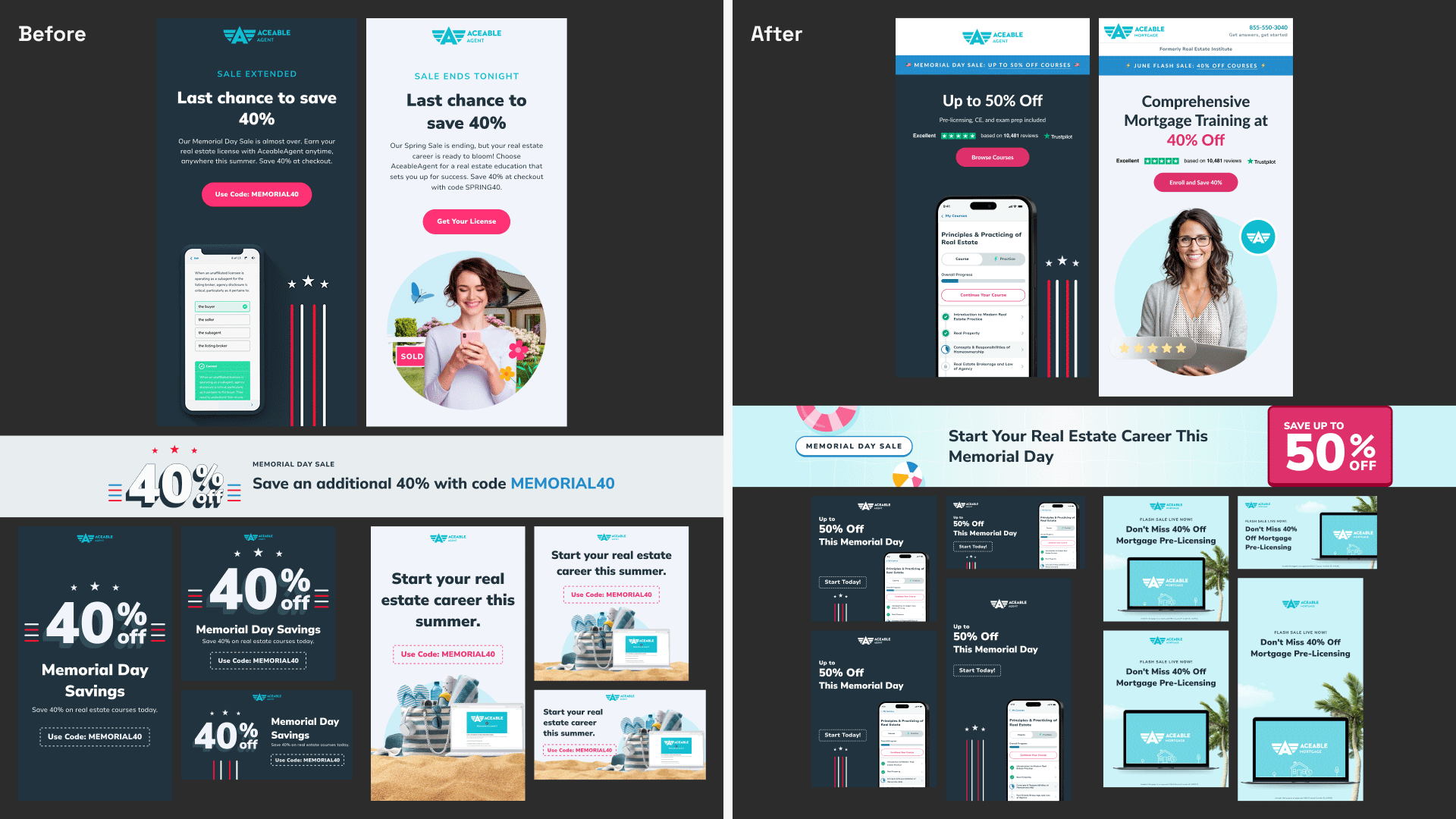
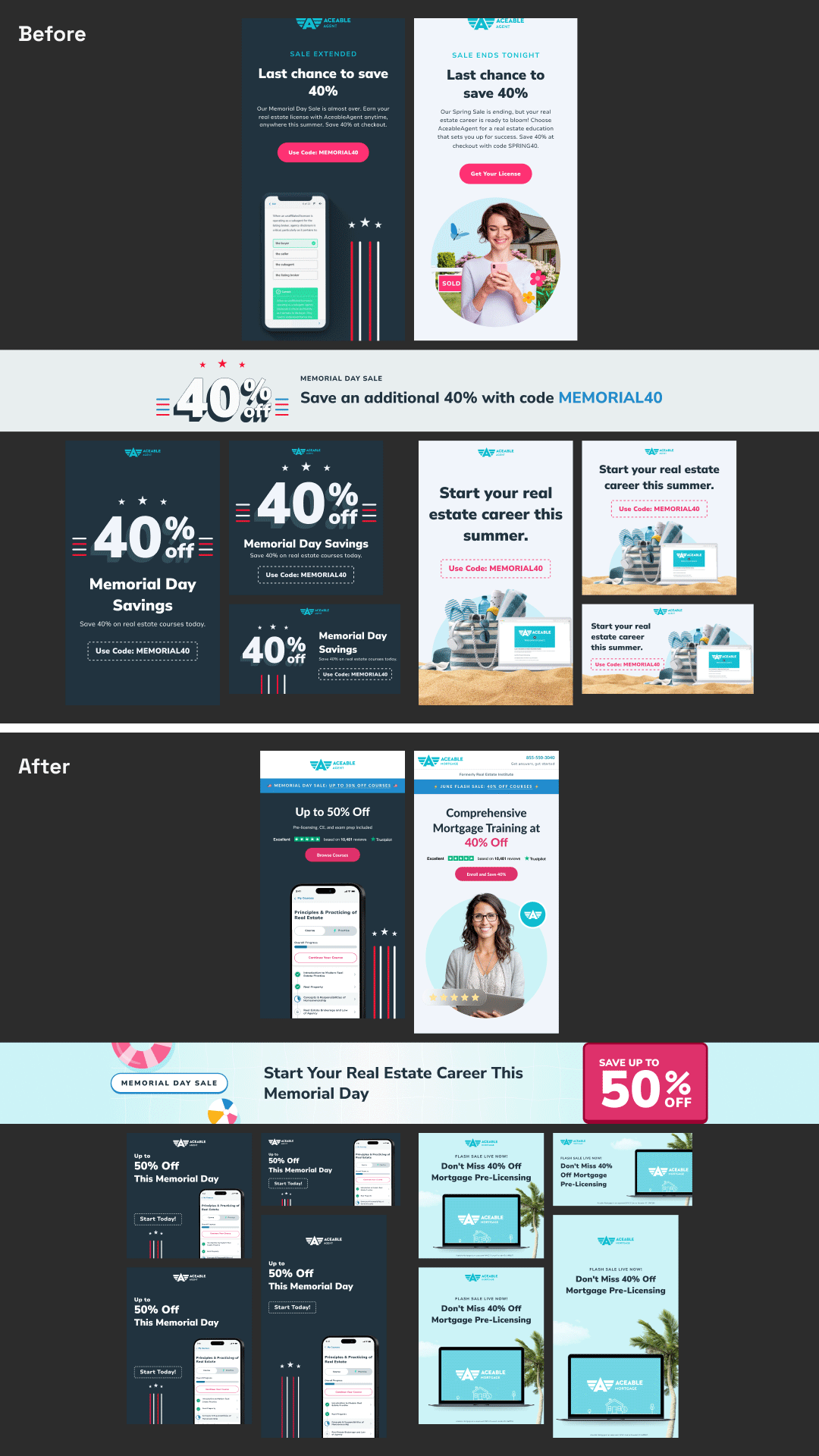
Early on, every campaign was built from scratch. The assets were good, but they sometimes felt disconnected, like they came from the same brand but not the same campaign. Production would take 20 to 30 hours, and with a small team and multiple stakeholders across verticals, that timeline was very hard to predict.
As the team grew smaller and campaigns got more demanding, it became clear that doing more of the same wasn't sustainable. The work needed a system, not just a process.
My Role & Collaboration
I own the creative end of campaign production at Aceable, from concept and asset design through final delivery. For sales campaigns I work closely with three to four marketing stakeholders, each managing their own vertical. They provide copy direction and campaign goals, and I translate that into visuals.
Over time my role evolved beyond execution. As I started identifying patterns and inefficiencies in the workflow, I began building the tools and systems that now support the whole process, including the CORE Image Library along with campaign templates in Figma, and eventually the Campaign Builder which I vibe-coded with Claude Code. What started as a graphics design role slowly evolved into a systems design role.
There's also a collaborative layer with content and marketing teams who now can use Campaign Builder directly. I built it with their workflow in mind, and their adoption of it helps the system grow and move faster.
The Process
Discovery & Inspiration
The turning point came during a particularly heavy campaign cycle. With multiple verticals, hard deadlines, and a smaller team, I started doing the math on how much time was going into work that was extemely repetitive. The creative decisions had already been made, the brand style existed, the visual language was established, but I was still rebuilding everything from scratch every time.
I started asking what a better version of this process could look like. Not just faster, but more consistent, more scalable, and less dependent on my bandwidth being available at the right moment. The answer wasn't a shortcut, it was a system.
I looked at where the real time was going: sourcing and generating imagery, resizing assets across formats, maintaining consistency across six verticals. Each of those was a problem that could be solved systematically rather than repeated manually.
Workflow & Tools
Campaign production at Aceable runs across six verticals, each of them needs a full set of assets per campaign cycle. My goal is to have my workflow support that scale without starting from zero every time.
The foundation is built in Figma. I maintain a set of campaign templates per vertical, designed to the exact specs each channel requires. When a new campaign comes in, I duplicate the previous cycle's file, swap the imagery and copy, and the layout, sizing, and brand constraints are already there.

The CORE Image Library lives in Figma too. It's a component-based collection of illustrations, icons, and hero images I've been building over the past 3 years. Because they're components, I can pull them directly into page designs, and the marketing team can access and export them independently without going through me.
For image generation I use a mix of edited stock photos, Midjourney, Gemini's Nano Banana, and Photoshop's generative fill to create campaign-specific visuals that fit the brand without relying on repetitive image banks.
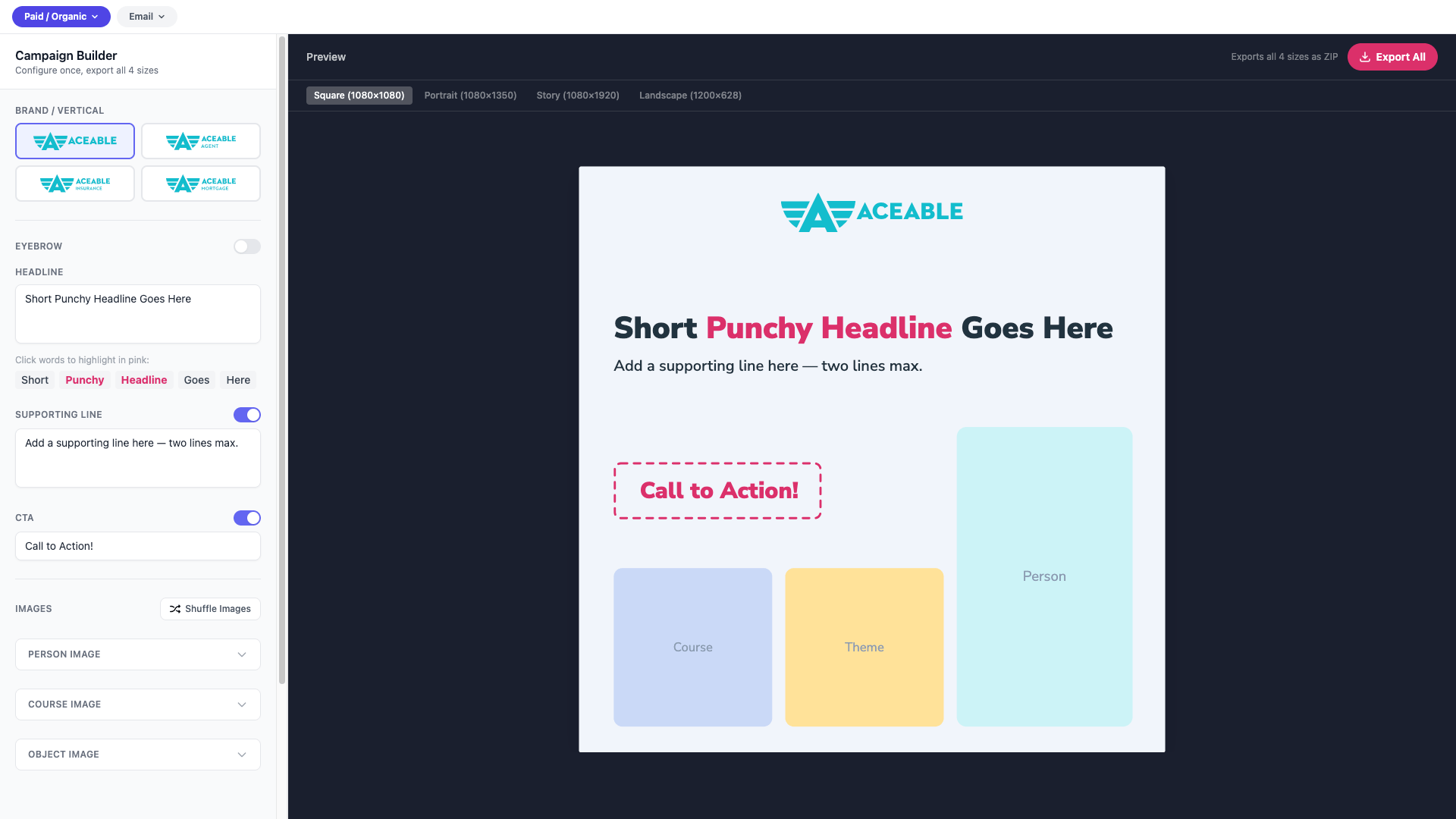
Campaign Builder sits on top of all of this. Built with Claude Code using Figma MCP so it could understand the template constraints, it lets the marketing team generate, preview, and download paid ads in multiple sizes, or build a full email and push it directly to Iterable. The imagery it pulls from lives in an image library in my Google Drive that I've been building since day one at Aceable, so everything stays on brand automatically.
Tools: Figma, Adobe Illustrator, Adobe Photoshop, After Effects, Midjourney, Gemini, Claude Code
Iteration & Feedback
The campaign work keeps naturally evolving through iteration. Each cycle builds on the last, and feedback from marketing stakeholders shapes both the visuals and the system behind them.
Early on, feedback was mostly about the assets themselves, composition, messaging hierarchy, how the mixed-media style translated across different verticals and formats. Over time, as the templates and library took shape, the conversations shifted. Now it's less about what something looks like and more about how fast we can move and how consistent the output is.
The Campaign Builder went through its own iteration cycle. I built the first version around the templates I already had, shared it with the content and marketing teams, and let their actual user experience guide what came next. Where they got stuck, I improved the UI. What they reached for most, I made easier to find. And it's still evolving, with more templates and formats on the roadmap.
That feedback loop, between the design work, the tools, and the people using them, is what keeps the system from becoming static. That way every campaign is a chance to make the next one better.
AI Integration
AI plays an important supporting role in this system.
For image generation I use Midjourney, Gemini's Nano Banana, and Photoshop's generative fill to create campaign-specific visuals that feel fresh and on-brand without relying on repetitive stock photography. These images are fed into the Google Drive library, keeping the asset pool current and varied.
The Campaign Builder itself, as mentioned before, was built with Claude Code, using Figma MCP so it could read and understand the template constraints I had already designed. That integration is what makes the tool feel like a natural extension of the design system instead of a separate attachment.
The goal throughout was the same: use AI where it removes friction and frees up time for the work that actually needs creative judgment.
The Solution
What started as a campaign design problem became a four-layer creative system, each piece building on the last.
The mixed-media brand style established the visual foundation, giving every campaign a consistent starting point regardless of vertical or format. The CORE Image Library in Figma cataloged that visual language into reusable components, so the whole team could access and deploy brand assets independently. Campaign templates in Figma brought reduced production time, with layout, sizing, and brand constraints already built in. And Campaign Builder put the whole system in the team's hands, letting marketing self-serve on-brand paid ads and emails without waiting on design bandwidth.
Each layer made the next one possible. The brand style informed the templates. The templates shaped the Campaign Builder. The image libraries feed both. It's a system that compounds itself.
Impact
Campaign production at Aceable looks very different than it did four years ago. Assets are more consistent, more on-brand, and faster to ship. The marketing and content teams can now generate and deploy campaign assets independently, without waiting on design bandwidth. The CORE Image Library has become a shared resource across marketing, product, and design, reducing one-off requests and making brand consistency easier to maintain at scale. What used to be a bottleneck is now a system that runs without me in the room.
Reflection
This project taught me that the biggest value in design work isn't always what is visible.
The campaign assets are what people see. But what made them possible, the templates, the libraries, the tool, that's what I'm most proud of. Building systems that let a small team move fast without losing quality or brand control is a different kind of creative problem, and one I didn't expect to find as satisfying as animation or illustration.
Looking back, every layer of this system came from paying close attention to where things were breaking down. Not waiting for someone to ask for a solution, just noticing the friction and deciding to do something about it.
That's the kind of designer I want to keep being.